
It is an entirely unoriginal observation that London, one of the most crowded and densely-populated cities in the world, is also a collection of villages. If you’re born or raised there, then there’s a good chance that, when asked about your childhood home, you will say you’re from Ealing, or West Ham, or Finchley, or Brixton. You probably won’t say I’m from London, because the next question will inevitably be which part of London?
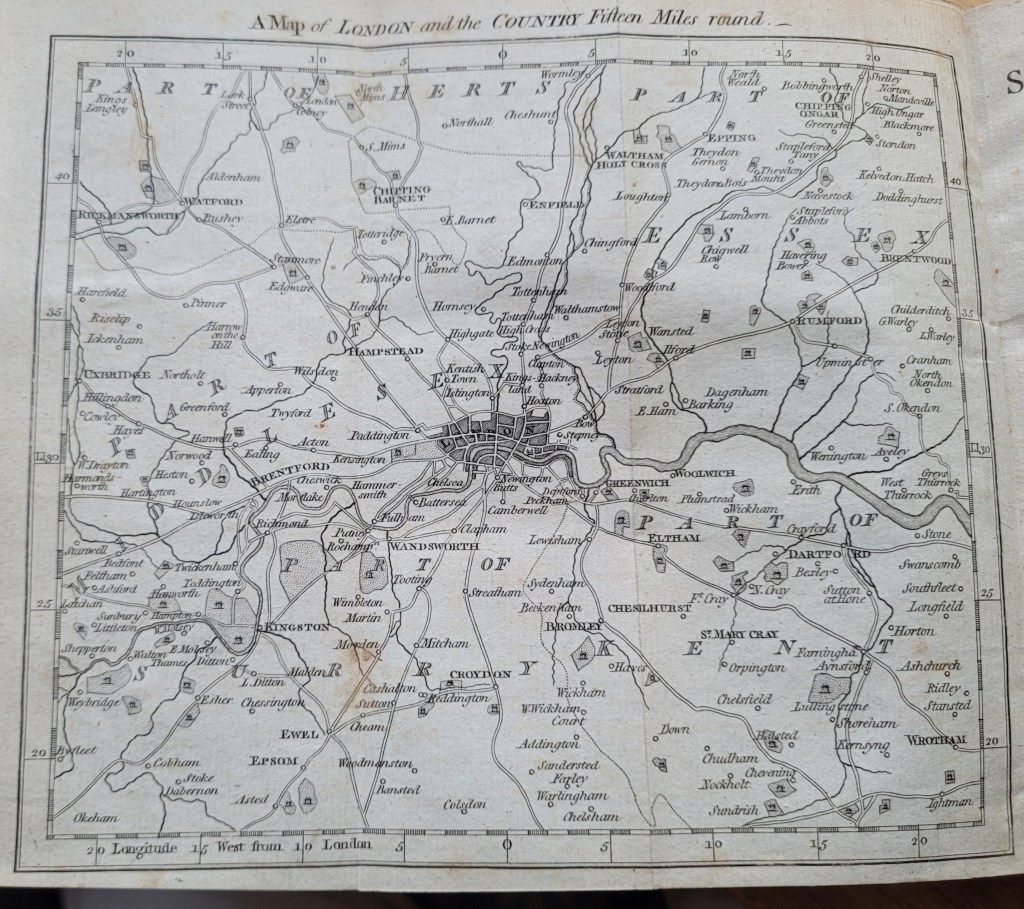
In my early years, my parents regularly moved house, so several London villages remain home to me, even after almost six decades resident in Scotland. Golders Green from age 2 to 7, Marylebone from 7 to 10, the West End from 10 to 16. Then they decamped 25 miles west of London to Windsor in Berkshire, and shortly thereafter I left for university in St Andrews and never went back except to visit.
If as a child you live with your family in your village and attend the local school, then you don’t have much reason to go to the next village or the next again. Which is true even if the villages are immediately adjacent to one another. So I know my own bits of London like the back of my hand, but the next suburb over? Never been there. South of the River Thames? Nothing worth going for. Kew? I’ve been by tube to the Royal Botanic Gardens but don’t really know where it is, or what else is there.
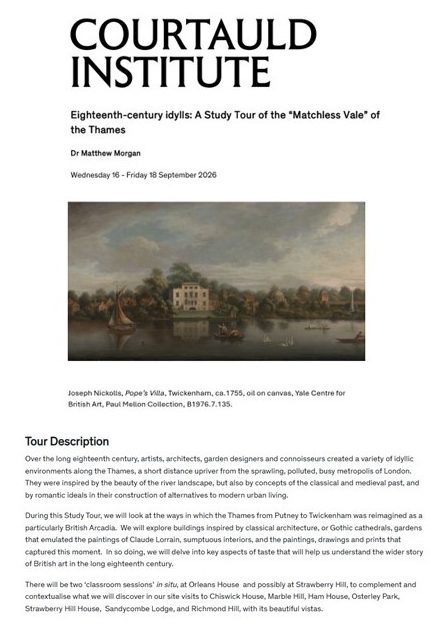
So, when Frances and I embarked on a Courtauld Institute of Art three-day study tour of the Matchless Vale of Thames, I was mostly venturing into unexplored territory. Born and brought up within a dozen miles’ distance, I might just as well have journeyed to Ouagadougou or Antananarivo for all that I knew about the local geography and built environment.
The last statement is not entirely true, but I wasn’t going to let truth stand in the way of rhetorical impact. I have indeed visited some spots in the Matchless Vale – to Richmond, where as a small boy I was taken to visit Great-Aunt Kitty in her rather grand mansion flat overlooking the river. To Twickenham a few years ago for a visit to Strawberry Hill House (written up on this blog here); and many times to Chiswick by car, but only for the purpose of revolving around the Chiswick Roundabout seeking access to the M4 motorway westbound.
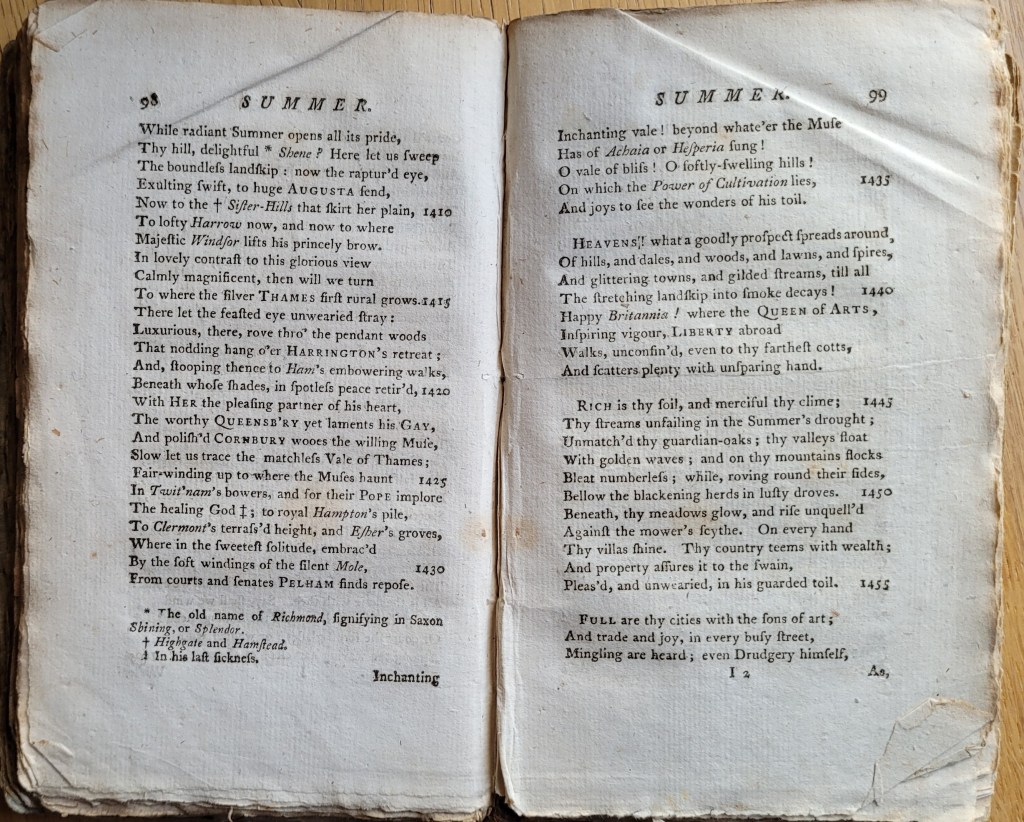
I’ve used the term Matchless Vale a couple of times and really should get on with explaining it. It’s the name given in 1727 by the poet James Thomson in his poem The Seasons to the stretch of the River Thames which can be viewed by looking west from the top of Richmond Hill. The same view is still there, astonishingly unspoiled, the only view in England protected by its very own Act of Parliament, passed in 1902 following pressure from powerful local worthies. The Act protected said view in its pristine state for the next 100 years – and then again for a further century when renewed in 2002.
James Thomson’s long (interminable) poem The Seasons was popular and highly influential on first publication, and re-printed regularly into the 20th century. I know this because upon examining my shelves of poetry books I find to my dismay that I own four copies, printed in 1789, 1811, 1854 and 1908 [1]. But for the present-day reader The Seasons is virtually unread and unreadable. I have tried on many occasions to read one or other of my copies but haven’t got past page 1 on any such attempt. Have a bash at the extract reproduced here, starting at line 1,406 of the Summer section, and you’ll soon see what I mean .
However, just a few lines from this excerpt contain the key to why I and Frances and eight other keen students gather on Day One at Orleans House Gallery in Twickenham, to meet our tutor and start on our study tour with an introductory lecture:
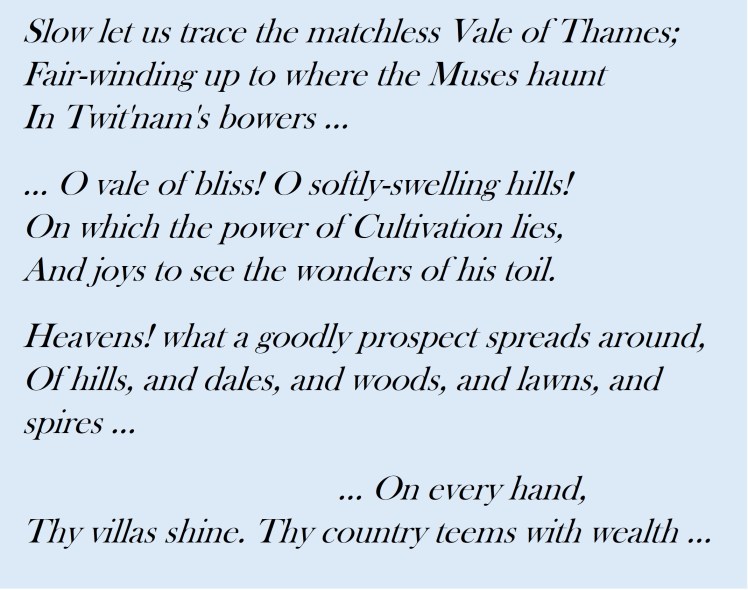
Yeah, that’s it. We’re here to see the shining villas and their gardens, and we’re here to see the wealth.
Our tutor and tour leader is Matthew, an art history specialist with mind-bogglingly impressive credentials including study at the Courtauld, and professional gigs at the Royal Collection, the National Gallery, the Wallace Collection, the Victoria & Albert Museum and Christie’s Auctioneers. He’s youthful (compared to his septuagenarian and octogenarian student group), full of enthusiasm and very well organised and prepared for the course.
Our group is, er, homogeneous. Ten people, all elderly, all well-educated and well-informed about art and art history; all non-diverse British residents except for one visiting white South African; all up for three days of learning and wonderment. There’s only one touch of diversity. That’s me. I’m the only bloke in the class.
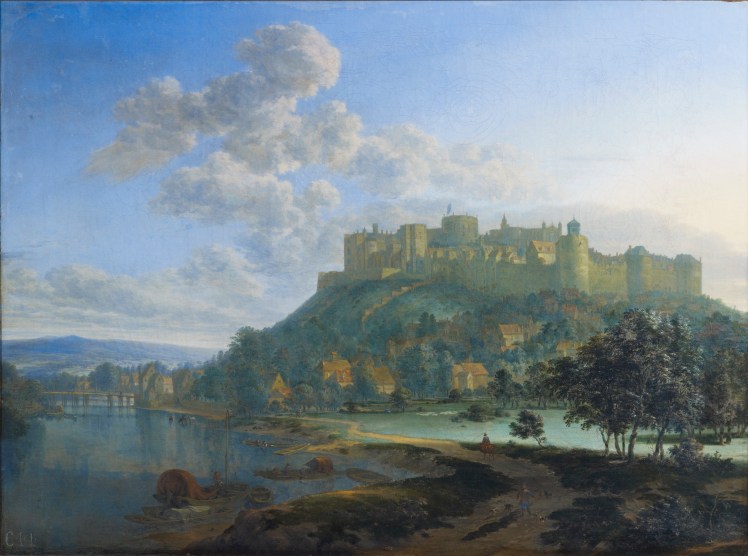
Grand houses, palaces and Castles have been built along the banks of the Thames to the west of the City of London since mediaeval times – Westminster Palace, Kew Palace, Hampton Court, Windsor Castle for the Royalty, plus other stately piles for the aristocracy. These are places where you can escape from the bustle of the city but still have easy access by fast-rowed boat downstream to your town house in St James’s or Mayfair. Over the centuries, more and more grandees found riverside plots upon which to build their houses, filling in much of the space on both sides of the river. By the early 18th century a Palladian villa in its own designed park in the Matchless Vale had become the ultimate signifier of possession of good taste, status and wealth (both old and new). A bit like Chipping Norton today.
And of course where the wealthy go, there also do you find the slightly less wealthy in search of praise, patronage and clientele – so that many of the smaller gaps between the great houses were filled up with the tasteful villas of the influencers of the day: notably the poet and style guru Alexander Pope, painters such as J M W Turner and Sir Joshua Reynolds, actors such as Sir David Garrick, authors such as Horace Walpole. And also villas built by or for the mistresses or concubines of the royal and rich, both current and cast-off.
That’s the context for our miniature Grand Tour, and now a little about the places we’re here to see. We’re immersing ourselves in what is sometimes called the long eighteenth century, which, when stretched to its longest, takes us from the Glorious Revolution of 1688 up to the accession of Queen Victoria in 1837.

Architecturally, we’re moving from the end of the period of H-shaped red-brick Stuart-period houses (like Ham House), through pure-white symmetrical Palladianism (Marble Hill House and Chiswick House), and into Neo-Classicism (Osterley Park interiors). On the way, we’ll look at a bit of late Baroque (the Octagon Room at Orleans House) and at the beginnings of the Neo-Gothic style (Strawberry Hill House) which set the trend for things to come in the 19th century. And as a contrast to mega-luxury, we’ll see the painter Turner’s modest fishing cottage (Sandycombe Lodge).
Horticulturally, we’re moving from the formal geometric parterres of the 17th century; through more informal gardens with level lawns around the villa, winding paths and small wildernesses; and on towards the rolling landscapes of Capability Brown, designed to make nature look more like painters’ depictions of Nature than like nature itself.
Our central focus is Palladianism, and before we can embark on a proper appreciation of the villas, we need to learn a little about Andrea Palladio (1508-1580), the great Italian Renaissance architect who built extraordinary villas for the wealthy of the Venetian republic. He took his inspiration from Roman architects, mainly Vitruvius, who floruit in the 1st century BC.
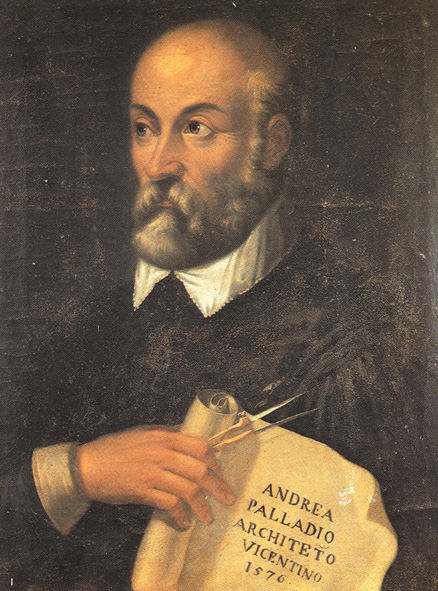
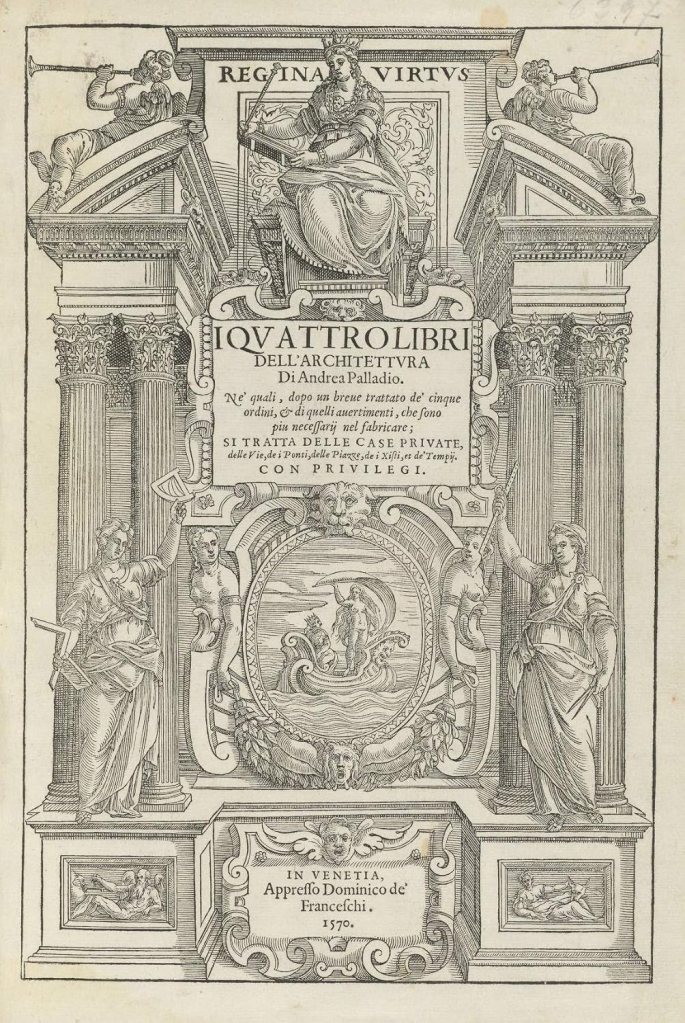
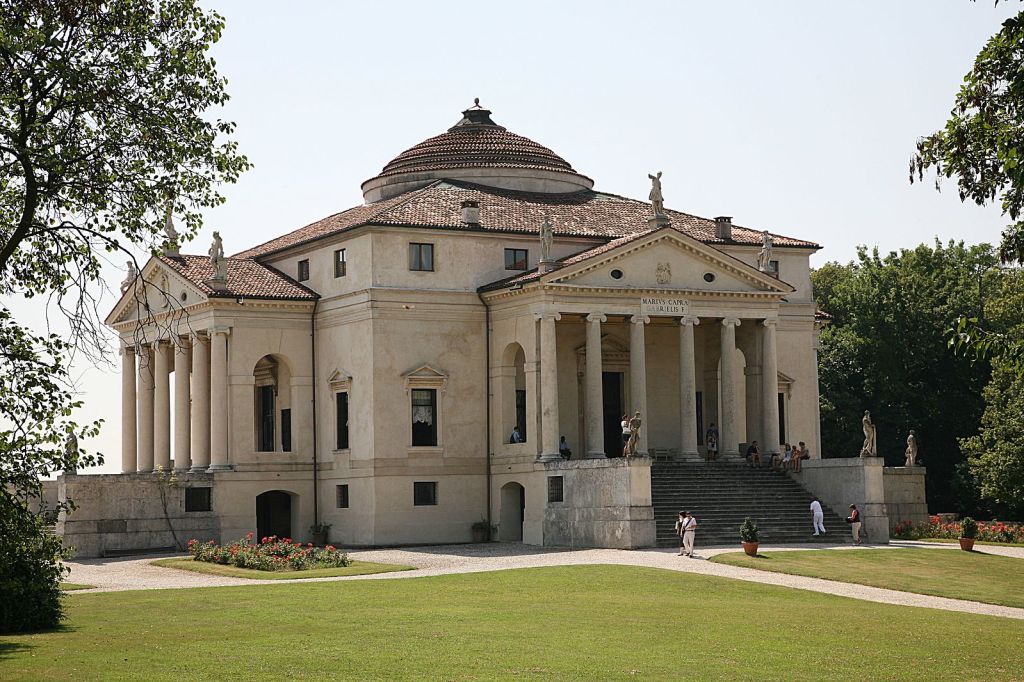
More than a century later, the first English translation of Palladio’s Four Books of Architecture (1715-’20) sparked a fad among aristocratic British housebuilders for building Palladian villas. This was much assisted by other publications, notably the architect Colen Campbell’s book Vitruvius Britannicus, published in three volumes between 1715 and 1725, containing engraved plans and elevations of most of the Palladian houses already existing in Britain.
The result? The construction all over Britain, in town and country, of beautiful, white, symmetrical party houses. The banks of the Thames to the west of London got the biggest concentration of them, which is why we’re on this tour. We can easily compare the villas which adorn the Matchless Vale by hopping between them on foot, or in a short bus ride, or – amazingly – by the tiny passenger ferry which plies by request across the Thames from Marble Hill House to Ham House and back (five minutes and two quid each way – see https://hammertonsferry.co.uk/).
Sadly, many of the great Palladian villas and houses have since been demolished. We’re here for the survivors. The stately progress of our tour is described in Part Two of this blog post, which you can jump to if you click on this link.
Note
[1] If readers think that owning four copies of Thomson’s Seasons is a little odd, please note that I own at least seven copies of an even longer and more unreadable and obscure poem, Edward Young’s Night Thoughts, published 1742-1745. This proves conclusively that owning a mere four copies of The Seasons isn’t odd at all.

