
Have you heard of Edward George Earle Lytton Bulwer-Lytton, 1st Baron Lytton of Knebworth in the County of Hertfordshire (1803-1873), who was so aristocratic that his surname appears three times in his full title? No? Then perhaps you have heard of Charles Dickens (1812-1870), who wasn’t aristocratic at all.

The two men were friends and contemporaries, and both were prolific popular novelists, churning out huge bestseller blockbuster novels year after year throughout the middle part of the 19th century. Posterity has treated them differently.
Take, for example, the year 1843, during which Dickens published his novella A Christmas Carol. If you haven’t read it (which you probably have), then you will surely at least know the story, from having had it read to you, or from seeing one or more of the many cinema and TV productions. Many impartial observers think that the best-ever film adaptation was The Muppet Christmas Carol of 1992, starring Michael Caine, Kermit the Frog and Miss Piggy.


Lord Lytton also had a book published in 1843, a novel entitled The Last of The Barons. It is unlikely that you will have heard of this particular book, and vanishingly unlikely that you will have read it. However, a working knowledge of The Last of the Barons, all 869 pages of it, is an essential prerequisite to full appreciation of this blog post.
But the Random Treasure blog has no wish to inflict cruel and unusual punishment on its readers. So your blogger set out to read the book on your behalf. I managed over several weeks to get through the first 316 pages before giving up, persuading myself that, at 76 years of age, there might be more fruitful and enjoyable pursuits for me during my scant remaining time on earth.
Those 316 pages were sufficient to give me a flavour. The Last of the Barons is set in England in the 1470s during the Wars of the Roses, the lengthy dynastic tussle for the English throne between the royal houses of York and Lancaster. The novel tells the story of The Earl of Warwick (“the Kingmaker”) and his relationship with King Edward IV.
As a measure of the extent to which Lord Lytton’s novel is forgotten and Dickens’s novel is remembered, let’s compare their current popularity scores on the Goodreads website [1]. A Christmas Carol has 885,795 ratings. The Last of the Barons has 27 ratings.
And here’s why: Lytton’s prose is, er, well, let’s just say it’s difficult. I have to be careful what I say here, because there’s a slight chance that this blog post might come to the attention of Lord Lytton’s descendant and successor Henry Lytton Cobbold, 3rd Baron Cobbold. I don’t wish to cause offence, your Lordship.
Below is an extended extract from page 159 of The Last of the Barons. Expand it in your mind to fill 869 pages, and you’ll know what it’s like to read this book.
But Edward, who, in common with all the princes of the House of York, carried dress to a passion, had not only reintroduced many of the most effeminate modes in vogue under William the Red King, but added to them whatever could tend to impart an almost oriental character to the old Norman garb. His gown (a womanly garment which had greatly superseded, with men of the highest rank, not only the mantle but the surcoat) flowed to his heels, trimmed with ermine, and broidered with large flowers of crimson wrought upon cloth-of-gold. Over this he wore a tippet of ermine, and a collar or necklace of uncut jewels set in filigree gold; the nether limbs were, it is true, clad in the more manly fashion of tight-fitting hosen, but the folds of the gown, as the day was somewhat fresh, were drawn around so as to conceal the only part of the dress which really betokened the male sex. To add to this unwarlike attire, Edward’s locks of a rich golden colour, and perfuming the whole air with odours, flowed not in curls, but straight to his shoulders, and the cheek of the fairest lady in his court might have seemed less fair beside the dazzling clearness of a complexion at once radiant with health and delicate with youth. Yet, in spite of all this effeminacy, the appearance of Edward IV was not effeminate. From this it was preserved, not only by a stature little less commanding than that of Warwick himself, and of great strength and breadth of shoulder, but also by features, beautiful indeed, but pre-eminently masculine,—large and bold in their outline, and evincing by their expression all the gallantry and daring characteristic of the hottest soldier, next to Warwick, and without any exception the ablest captain, of the age.
“And welcome,—a merry welcome, dear Warwick, and cousin mine,” said Edward, as Warwick slightly bent his proud knee to his king; “your brother, Lord Montagu, has but left us. Would that our court had the same joyaunce for you as for him.”
Get the picture? In our age it’s difficult to appreciate this kind of writing, bursting with archaisms and overwhelmed by subordinate clauses. Some writers of historical novels can pull this kind of thing off with style and panache (take for example Ford Madox Ford in his extraordinary but now-forgotten trilogy The Fifth Queen of 1906-’08). Others, such as Hilary Mantel in her Wolf Hall trilogy, succeed in conjuring up a convincing Tudor atmosphere while keeping the archaic grammar and vocabulary to an absolute minimum. Lytton, sadly, fails on all fronts.
In the short period of years after publication of the Last of the Barons and before its permanent disappearance into total literary obscurity, at least one reader was hooked by the picturesque mediaevalism of Lord Lytton’s prose. This reader was the painter Daniel Maclise, who wrote Lytton a fan letter [2] on 27 January 1849, in which he said:

… I have been engaged in designing subjects, all the requisites for which I have found condensed in your pages, both for customs, costumes and all learned reference.
I am engaged on a subject of Caxton at his Printing Press, and intending to pourtray the Printer exhibiting his process and proofs in the Almonry at Westm[inster] to Edward IV & his Court. I have derived every idea I required from “The Last of the Barons” …
The artist Daniel Maclise has featured in this blog before, in a piece which I wrote some years ago entitled Outmoded But Not Forgotten. If you want to get full satisfaction out of this posting, then you really should go back and re-read (or read for the first time) what I wrote then. The blog posting is considerably less than 869 pages, but if you still can’t be bothered to read it, I’ll provide a brief summary here.
The completed painting that Maclise was describing in his fan letter to Lord Lytton was entitled Caxton Showing the First Specimen of His Printing to King Edward IV at the Almonry, Westminster. It was first shown in public at the 1851 Summer Exhibition at the Royal Academy in London. It was big – around 7 feet high and 11 feet wide – and it looked like the image below, but in colour:

It’s a fairly straightforward Victorian narrative picture, showing a busy, crowded interior. In the centre are a young couple (the King and his wife Elizabeth Woodville), accompanied by their children Elizabeth, Edward, and Richard. Beside them is their host William Caxton, who is showing off his remarkable apparatus, the first moveable type printing press in England. There’s a crowd of onlookers from the royal party, including several soldiers in armour, and there’s a disgruntled-looking monk. Other figures are practising the trades of printing including typesetting, bookbinding and inking. Apprentices help to work the press. A dog is watchful. The tableau is an imagined reconstruction of an actual event which took place in the year 1477.
Seven years after the painting was first exhibited, a mass market reproduction was issued in the form of a large black-and-white engraving (as shown above). I bought a copy of this engraving in an auction and hung it above the fireplace in my study. My example is a rather special one because it’s hand signed by both the artist Daniel Maclise and the engraver Frederick Bromley.
My former blog posting was mostly about the engraving.
Maclise’s Caxton painting was judged as “the picture of the year” [3] when it first went on display in the Royal Academy 1851 exhibition. By contrast, in the same show, Sir Edwin Landseer’s Monarch of the Glen, now considered one of the greatest of Victorian pictures, was scarcely noticed by the critics. Early offerings by members of the Pre-Raphaelite Brotherhood were dismissed as joke pictures displaying “an absolute contempt for perspective and the known laws of light and shade, an aversion to beauty in every shape” [4].
Lord Lytton had of course been aware since receiving Maclise’s letter of January 1849 that the artist was at work on the composition. When he finally saw it at the exhibition, was he was highly impressed:
“[It] charmed me as effecting the exact union between sentiment and execution, which is the true and rare consummation of the idea in Art” [5]

In particular, he noticed the miserable Monk standing at the left-hand side of the picture observing Caxton’s demonstration:
“That monk, with his scowl towards the printer and his back on the bible, over which his form casts a shadow – the whole transition between the mediaeval Christianity of cell and cloister, and the modern Christianity that rejoices in the daylight, is depicted there, in the shadow that obscures the Book – in the scowl that is fixed upon the Book-diffuser …” [6]
At the end of the exhibition, the painting was in the possession of the writer and biographer John Forster, who, like Charles Dickens and Daniel Maclise, was a friend and crony of Lord Lytton. When Forster died some years later, the next owner was Lord Lytton’s son Robert, first Earl of Lytton, who, among many other notable honours and achievements, became Viceroy of India [7].
Thereafter the painting remained in the possession of successive generations of the Lytton family at their family seat of Knebworth House, a huge Tudor-style mansion house near Stevenage in Hertfordshire.
Knebworth House is probably best known today as the venue for its rock concerts, held in the grounds. You could have gone there to see the likes of Pink Floyd, The Rolling Stones, Led Zeppelin, Queen, Paul McCartney, The Beach Boys and Elton John.

I haven’t yet had the pleasure of visiting Knebworth either for a concert or to view the interior, but the website reveals that for a fee you can gain entrance to the house, whose external appearance “with its turrets, domes and gargoyles silhouetted against the sky, does little to prepare the visitor for what to expect inside” [8].

What you’ll find inside are opulent interiors in the highest of high Victorian taste. And there, in the State Drawing Room, hanging to the right of the fireplace, you’ll encounter Daniel Maclise’s magnificent 1851 painting of Caxton Showing the First Specimen of His Printing to King Edward IV at the Almonry, Westminster.
Below is a photo which was posted by Knebworth House on Facebook in 2022. Take a good look at it. Compare it with the black-and-white engraving reproduced above. Can you spot the difference?
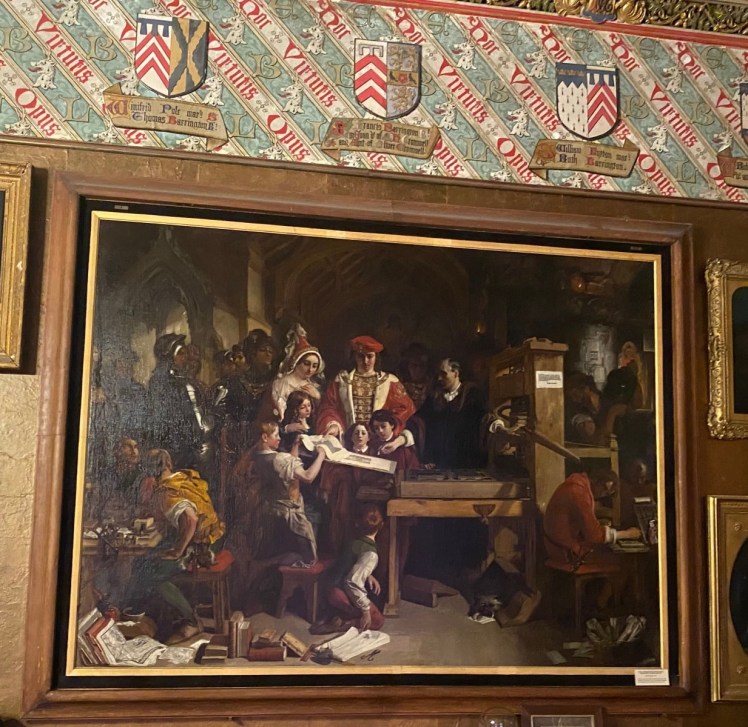
Yes, there’s a mystery. It’s the scowling Monk. He’s gone.
Why he had to go, and who expelled him from the picture, are the topics for investigation in Chapter 2 of the Missing Monk Mystery, which you can read here
Click here for Chapter 2
Notes
[1] https://www.goodreads.com/
[2] Unpublished letter in Knebworth House archives, image supplied by Jill Campbell, Archivist
[3] The Journal of William Charles Macready, 1832-1851, edited by J. C. Trewin, p. 296, SIU Press, Carbondale, 2009
[4] The Times, 3rd May 1851
[5] Quoted in The Art Journal, October 1860, page 255
[6] Ibid.
[7] By a strange coincidence, my last Random Treasure ramblings also featured a Viceroy of India, Archibald Wavell, the first Earl Wavell (read it here). One day soon, you might get yet another piece about yet another more or less obscure Earl about whom I have a story: the first Earl of Minto, who was the colonial Governor-General of India in the years before the job was upgraded to Viceroy. But that story’s for another day.
 Random Treasure
OMG what happened to the poor Monk? Suspense builds.
LikeLiked by 1 person