
If you haven’t read Slice 1 and Slice 2 of of this 5-slice Random Treasure blog post, I suggest that you go back to the beginning by clicking here . Unless, of course, you like to start in the middle. Whichever you decide, the background to this narrative is an enquiry by your blogger into the baking of a loaf of bread which won first prize in a home-baking competition held in St Bees, Cumbria in August 1907.
Slice 1 was about The Prize Competition and Slice 2 was about The Prize. This Slice 3 is about The Prize-Giver, and will be followed by two more Slices:
Slice 3: The Prize-Giver
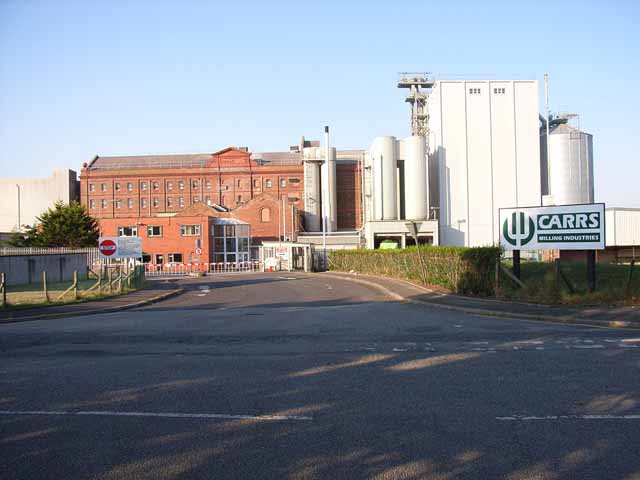
Carr’s Flour Mills were the people who awarded the Handsome Tea Service as the cometition prize. But the name of Carr’s printed on a packet of flour didn’t seem to ring any bells with me. Perhaps the company disappeared years and years ago – taken over and absorbed into some other company, or bankrupt and defunct? Perhaps their flour mill had been flattened long since and replaced by a housing estate or a shopping mall? I looked them up and discovered how wrong I was:
Carr’s still exists today, milling vast quantities of flour at their three mills – at the original mill still going strong at Silloth near Carlisle, at the Hutchisons Mill in Kirkcaldy, Fife (now their head office), and at the Maldon Mill, Essex. Carr’s flour milling business was sold for £36 million in 2016 to the Whitworth’s group but still operates as a separate subsidiary of the holding company.
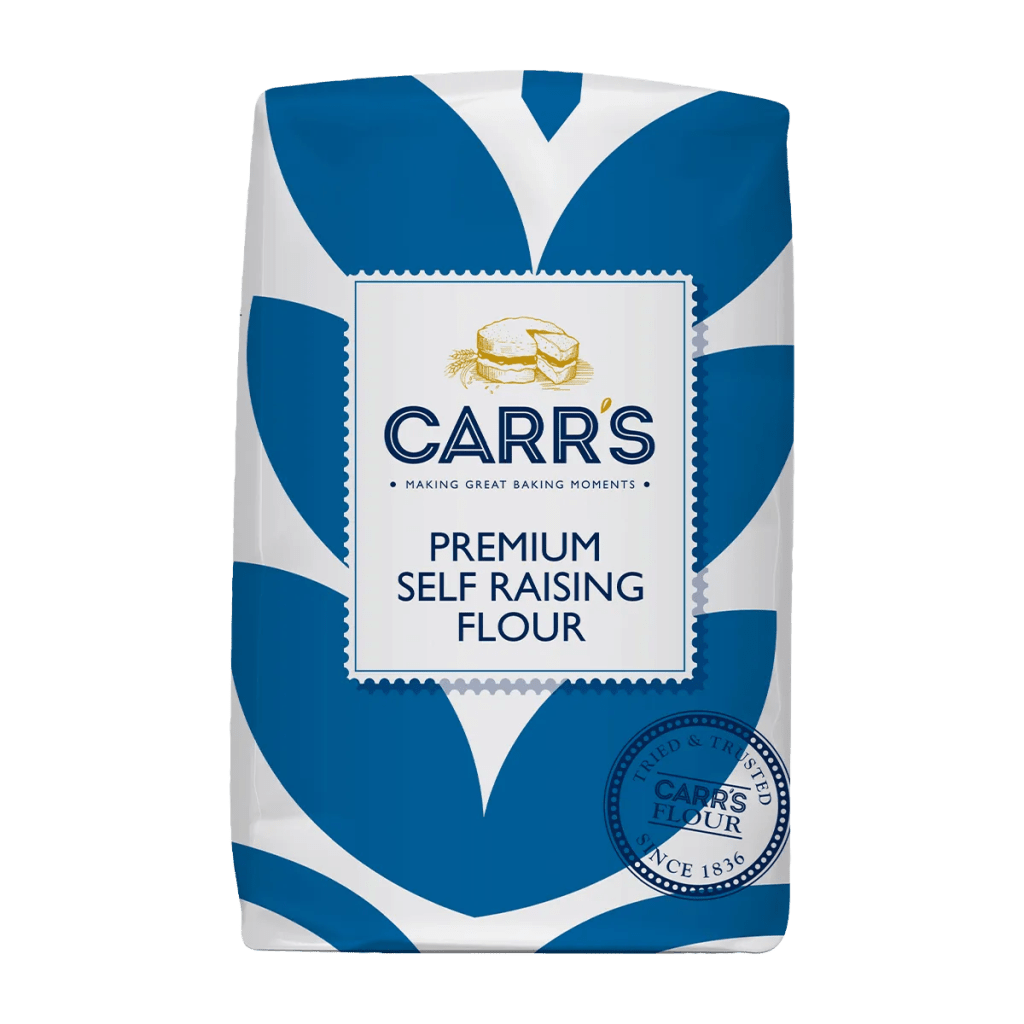
Carr’s flour is still available in supermarkets – but not in supermarkets that I frequent, and to whose home baking aisles I am a frequent visitor. I might not have mentioned in this blog before that when I’m not busy blogging I am often to be found in my kitchen baking cakes and scones. So I buy quite a lot of self-raising flour – but usually the supermarket’s own brand, being much too stingy to pay for premium brands.
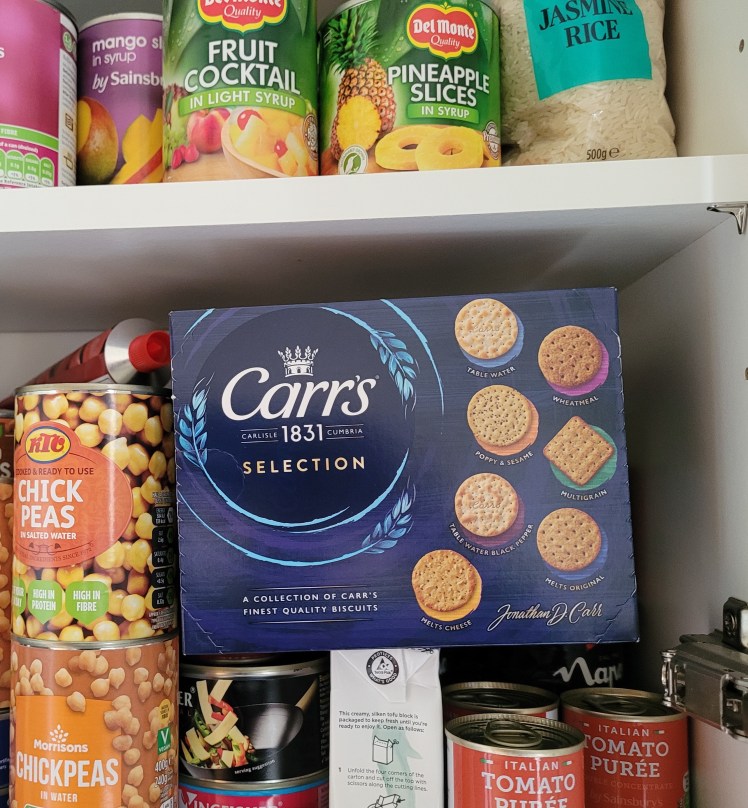
Carr’s name is indeed familiar to me, and also probably to you. I simply hadn’t made a connection between the miller of Carr’s flour and the baker of Carr’s Table Water Biscuits, an ancient and renowned biscuit brand much favoured in days of yore by my late Mother, a brand which I have spent a lifetime trying to avoid: too dry, too plain, not sweet, not salty, too earnest (the biscuits, not my Mother). There’s no such connection now, because today the Carr’s Biscuit brand is owned by a different company called Pladis Global through its subsidiary United Biscuits. Incidentally, I opened our pantry cupboard door the other day and found a packet of Carr’s assorted cheesy biscuits, left over from a Christmas Past, unopened but still miraculously in-date.
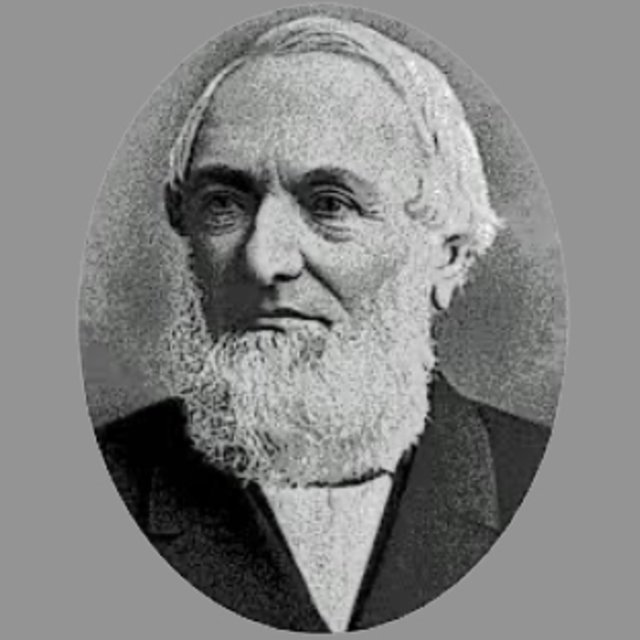
Jonathan Dodgson Carr (1806-1884) was a Quaker businessman and social reformer. Thanks to information kindly supplied by my friend William (a bookseller and a keen reader), I have become aware that J D Carr is the subject of a 1997 biography (which I haven’t yet read) entitled Rich Desserts and Captain’s Thin 1 by the novelist Margaret Forster.
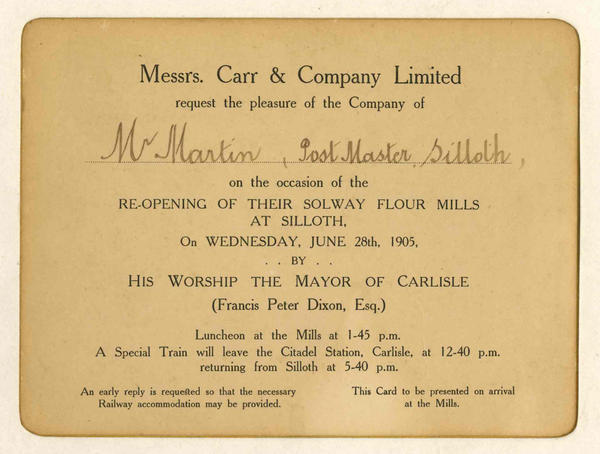
He first built a mill at Silloth in 1836 to supply flour for his Table Water Biscuit factory. The mill was completely re-built and re-opened (by His Worship the Mayor of Carlisle) in 1905, so it’s easy to imagine that a huge increase in flour production from the new facility would be accompanied by a corresponding increase in advertising and marketing spend.
I’m guessing that this is the background to the award of prizes at agricultural and flower shows in the mill’s catchment area and beyond – over an area extending (as we have seen) from Silloth near Carlisle at least 32 miles to the south to St Bees and 72 miles to the north to Lilliesleaf.
But this has to remain guesswork, because I drew a complete blank when I phoned the Silloth and Kirkcaldy mills to ask if they have retained in their archives a record of the prize promotions. They said they haven’t kept any such records at all, but put me on UK Flour Millers, an august and venerable trade association founded in 1878 2.
Sadly, UK Flour Millers have no records pertaining to Carr’s sponsorship of baking competitions in 1907, but the very helpful person there told me about the Mills Archive Trust, the “registered charity dedicated to the protection and preservation of the records of milling history” (https://millsarchive.org/). Their archivist was also very helpful but was unable to find any specific information. He did, however, point me to a collection of relevant images which you can see here.
Research in local newspapers reveals that 1907 wasn’t the first time that Carr’s sponsored baking competitions. A similar campaign was promoted in 1906 but the prizes didn’t include Handsome Tea Services. At the Aspatria show (and presumably elsewhere), the 1906 winners received: 1st, a silver plated teapot, value £1/15s/6d; 2nd, a silver plated coffee pot, value £1/8s/6d; 3rd, a silver plated biscuit barrel, value £1; 4th, a silver plated jam dish, value 10s/6d 3.
I haven’t looked up 1908 or following years to find out if the promotion was repeated subsequently.
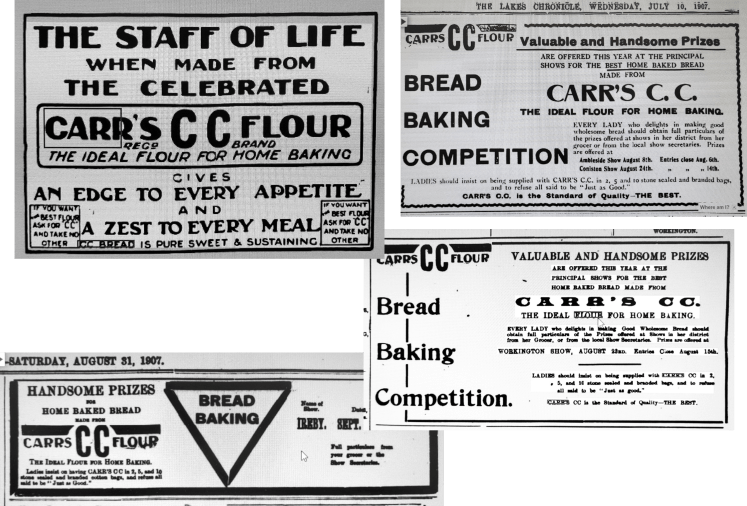
These advertising and sponsorship campaigns must have been expensive. In preparation for the 1907 competitions the management at Carr’s bought in a huge supply of handsome tea services, biscuit barrels, bread knives, and jam jars and spoons – one of each for each competition to be sponsored, more than 20 sets of prizes in all. Plus the cost of regular noticeable advertising in many local weekly newspapers. They must have expected to sell a lot of flour.
The bulk of the flour produced at the mill was presumably sold in big quantities to commercial bakers of all sizes locally and nationally. But retail sales in grocery shops must have been a significant market segment, of sufficient size and potential for growth to make it worthwhile for Carr’s to sponsor competitions at local annual shows. But what did the ladies who bought Carr’s CC Flour do with it once they had bought it?
It’s time to consider the Prize Loaf. Read about it and its ingredients and recipe in Slice 4, coming next.
Now Read Slice 4: The Prize Loaf
Notes
- https://www.amazon.co.uk/Rich-Desserts-Captains-Thin-1831-1931/dp/0099748916 ↩︎
- Incidentally, note that UK Flour Millers (https://www.ukflourmillers.org/) have their offices at 21 Arlington Street, London. This address might be of interest to keen readers of the Random Treasure blog, because by a remarkable coincidence previous posts in this blog have touched upon events at other addresses in the same short street: the drowning of a cat at Number 4 (read about it here), and the death of a banker at Number 20 (read about it here). ↩︎
- West Cumberland Times, 22 September 1906, Page 3, retrieved from British Newspaper Archive ↩︎
 Random Treasure
Having seen your tea cups from the tea service, I feel that the second or third prize of the biscuit barrel was far higher on the scale of handsomeness. Certainly the now much lamented one that passed through my hands was and it also held value better.
I don’t remember any particular place being mentioned on the inscription so I suspect Carr’s must have bought a job lot and had them all inscribed together.
I was surprised to read your sad tale of a poorly competed and attended show. It may well depend upon location but the village halls of my North Yorkshire are well used and any such show is still fiercely competitive. Especially since Covid, when there was a massive revival of home baking and crafts generally.
If only I could win another Carr’s biscuit box with one of my splendid sour dough loaves…
Jos.
P.S. Buy that premium flour, you will be surprised at what a difference it makes. Especially when making bread.
LikeLiked by 1 person