
I hope you have read Slice 1 of this 5-slice Random Treasure blog post. If not, this Slice 2 won’t make much sense to you (it might not make much sense anyway). You should know by now that your blogger has been making enquiries into the baking of a loaf of bread which won first prize in a home-baking competition held in St Bees, Cumbria in August 1907.
Slice 1 was about the Prize Competition. This Slice 2 is about the prize. Look out for three more Slices, all coming soon:
Slice 2: The Prize
Out of the array of home-baking prizes (from First to Fourth) on offer from Carr’s Flour Mills in the St Bees show, I’m interested for the purposes of this blog post only in the First Prize: the Handsome China Tea Service (40 pieces) presented to Mrs Taylor, and in the other tea services awarded to other winners in the other shows.
Where did Carr’s get the tea services from? Who made them? How many were ordered and by whom at the flour mill? How much did they pay? And why am I so interested?
Yes indeed, I can hear my readers muttering restively: What’s the cause of this blogger’s sudden preoccupation with village flower and produce shows? Where’s the Random Treasure? Why am I reading this?
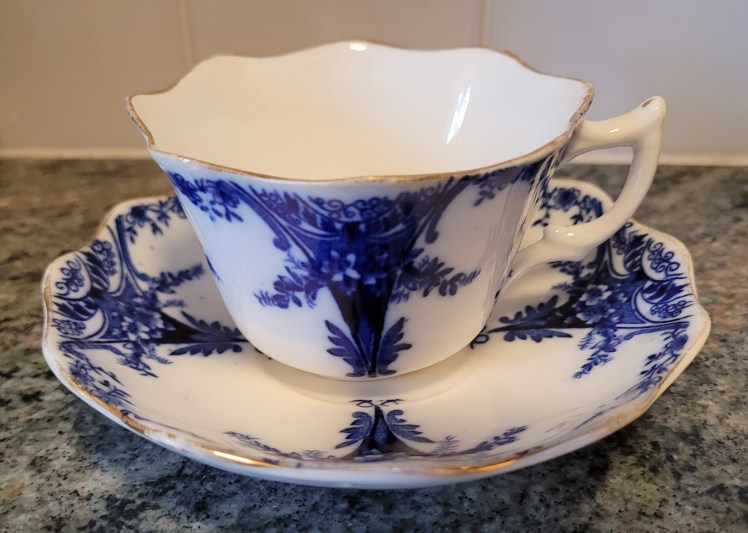
Simple answer: because four pieces from Mrs Taylor’s tea service (or from one of the others) turned up in an Edinburgh charity shop last week.
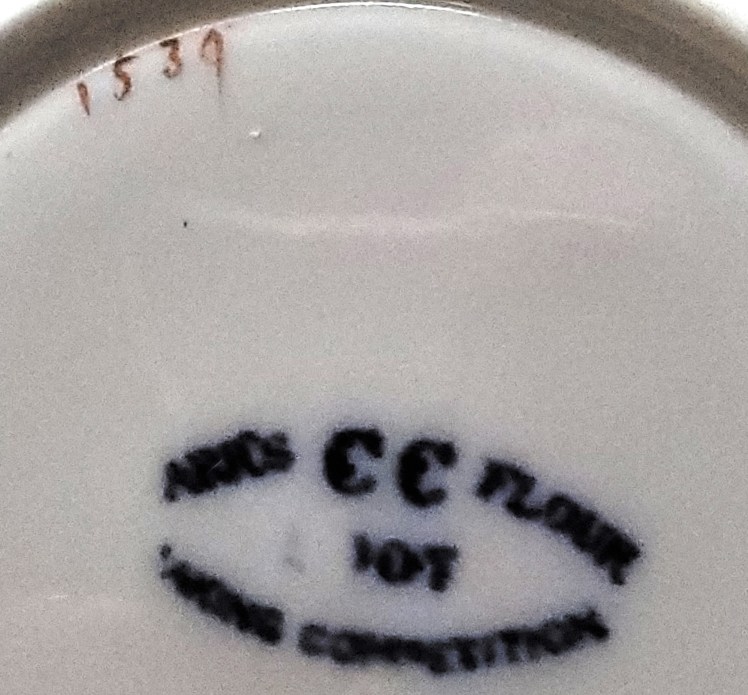
There can be no dubiety about their provenance because each item bears on its base a special printed inscription in underglaze cobalt blue as follows:
CARR’S CC FLOUR
1907
BAKING COMPETITION
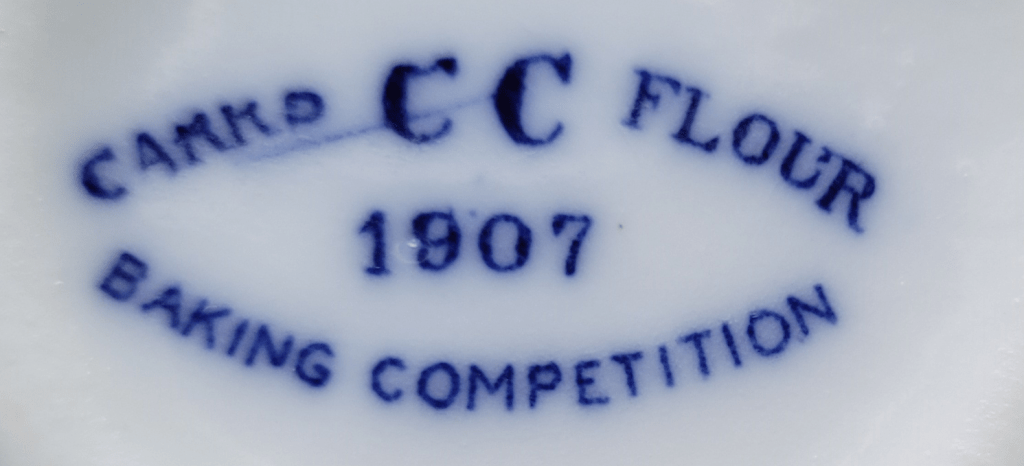
Readers will know from previous blog posts [1] that I can’t resist buying ceramics bearing their dates of manufacture, so you’ll understand why I forked out the fiver for the two cups and two saucers and brought them home for research.
Clearly the makers of Carr’s CC Flour had placed a special order for the teawares from a pottery manufacturer. But from which factory? This was quite a simple question to answer, because some online searching soon found examples of identical cups and saucers which bore the manufacturer’s own generic backstamp including their initials, wares obviously made for general sale and not part of the order specially marked as prize items for Carr’s.
This generic backstamp is shown in the image below, taken from a listing on eBay [2] :
FOLEY EST. 1850 CHINA
R & S
TRADE MARK
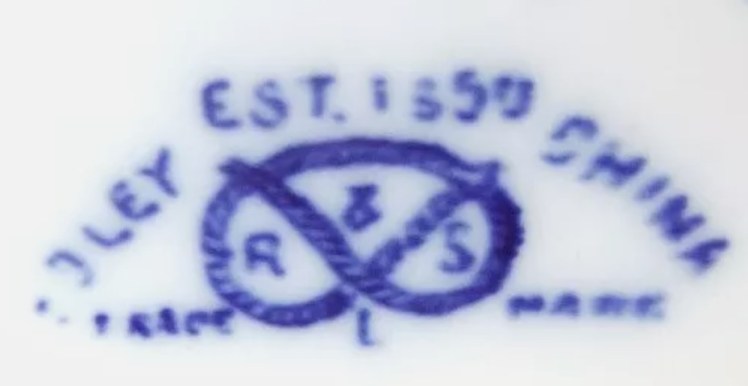
Thus we know that the tea services were made in the Foley China factory – but this identification is not quite as straightforward as it might seem. Foley is a district of Fenton, one of the Five Towns of Stoke-on-Trent in Staffordshire, where there were at least five potteries in operation, all of which used the name Foley in their company names or trade names or product names.
The resulting confusion led in 1910 to a lawsuit between some of the potteries, which in turn led to some of them changing their names. For example, the best-known of the factories, Wileman & Co, changed their name to Shelley Pottery. Less well-known was the factory of E. Brain & Co. Ltd., which retained the right to use the name Foley China.
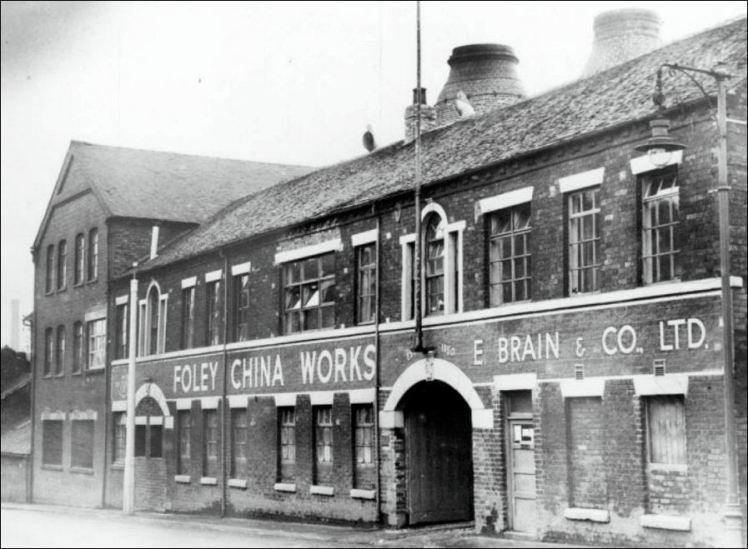
Originally established in 1850 as Robinson & Co., the factory was taken over in 1885 by Mr Elijah Brain, who re-named the company E. Brain & Co. Ltd. However they continued for some years to print on the underside of their wares the former R&S initials for Robinson & Co, inside a Staffordshire Knot device as shown in the image above.
Some time in the early 20th century Elijah Brain’s son William Henry joined the firm, under whose direction:
the business continued to prosper and expand. Especially was this the case perhaps in those spacious years before the first World War, when he introduced new decorative styles which created such a demand that a minor revolution in design was effected within the trade, the lead thus given being copied by many other firms”[3]
The factory:
specialised in bone china tea and breakfast wares of high quality and good design … for a market which was steadily growing. Much high quality “hotel ware” china was specifically designed and produced for use by shipping lines on the great ocean liners.[4]
So it seems that the marketing people at Carr’s flour mill went to a quality supplier to procure the handsome tea services which they awarded as home baking competition prizes: a supplier which specialised in making special orders for special purposes.
In addition to the unique competition backstamp, my two saucers are also hand-inscribed in red on the base with the number 1539, which is a pattern number identifying the pretty art nouveau influenced design of flower garlands and curlicues printed in underglaze cobalt flow blue.
There’s no doubt about it. The delicate bone china tea services won by Mrs Taylor and others in the 1907 shows were of high quality and high fashion in those genteel and prosperous Edwardian times.
The firm of E Brain & Co. Ltd. no longer exists. In the early 1960s Brain’s absorbed the Coalport name and business, and a few years later was itself absorbed by Wedgwood. I have written to the Wedgwood Archive to ask if they might have retained any old order books from Brain’s Foley factory, but at the date of publishing this post I haven’t received a reply. So I’m afraid I can’t tell you who it was from Carr’s who ordered the tea services from Brain’s, or how many sets were commissioned, or the date of the order or of the delivery, or the price paid.
Having given an account of the Competition in Slice 1, and an account of the Prize in this Slice 2, I’ll be introducing you in the next Slice to Carr’s the flour millers, who sponsored the competition and awarded the Prize. Stand by for Slice 3.
Now Read Slice 3: The Prize-Giver
Notes
[1] See previous posts here and here
[2] https://www.ebay.co.uk/itm/404392410783
[3] Quoted at https://www.thepotteries.org/allpotters/160.htm
[4] https://foleychina.com/history/. In 1936, Foley designed and manufactured the dinnerware for the Cunard liner RMS Queen Mary.
 Random Treasure