
Your Random Treasure blogger has been making enquiries into the baking of a loaf of bread. Not any old loaf, but a very special loaf, so special that it won first prize in a home-baking competition held in Cumbria in August 1907.
My findings – or should I say my musings? – are sliced into five Slices, and each Slice will be served to you in a separate blog post. And why not?
Here is Slice 1: The Prize Competition
Look out for the sequels:
Slice 1: The Prize Competition
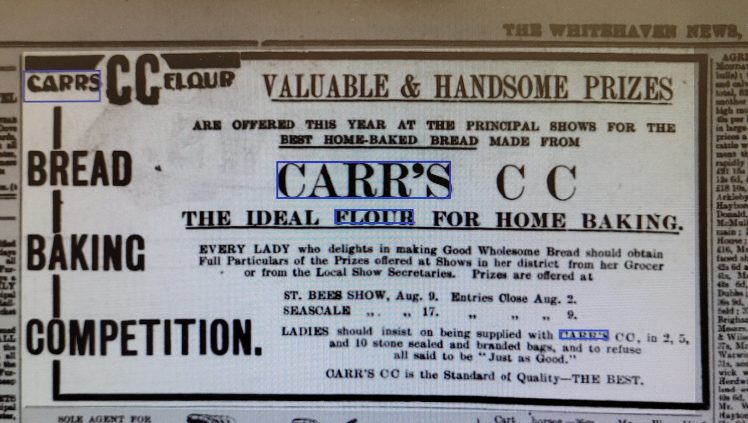
It’s Friday 9th August 1907. Despite the gloomy, threatening weather, heavy advertising has ensured that there’s an excellent turnout at the St Bees Horticultural Society’s second annual exhibition, held in a large marquee erected near the cricket pavilion [1].
If you’re unfamiliar with St Bees, it is a village with a current population of some 1,800, on the Cumbrian coast about five miles from the market town of Whitehaven.
The exhibition attracts 660 entries in a large number of classes of endeavour. There are prizes to be won. The baking competitions are to be judged by Mrs Porter of Tangier Street, Whitehaven. One of the categories is Home Baked Bread Made From Messrs Carr & Co. Ltd.’s CC Brand Flour.
Mrs Porter’s judgments are as follows:
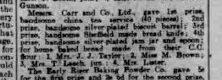
- 1st Prize: a handsome china tea service (40 pieces) – Mrs J J Taylor
- 2nd Prize: a handsome silver plated biscuit barrel – Miss M Brown
- 3rd Prize: a handsome Sheffield made bread knife – Mrs T Leach
- 4th Prize: a handsome silver plated jam jar and spoon – Mrs Lister
Other similar flower shows and agricultural shows take place up and down the Northern reaches of England during the course of that summer.
- 25th July: Longtown
- 5th August: Balston
- 8th August: Kirkbride, Keswick, Ambleside
- 10th August: Aspatria
- 17th August: Seascale
- 24th August: Coniston
- 28th August: Ennerdale & Kinniside
- 29th August: Wigton, Cockermouth
- 31st August: Mealsgate, Bootle, Workington (opened at 2 p.m. by the Mayoress)
- 12th September: Loweswater
- 18th September: Millom & Broughton
- 26th September: Ireby
There may have been other shows which I haven’t tracked down. At each one, a similar competition was held to that at St Bees. The people from Carr’s Flour Mill awarded Valuable & Handsome Prizes for the best home-baked bread made from their CC Flour. That’s a lot of home-baked bread and a lot of prizes.
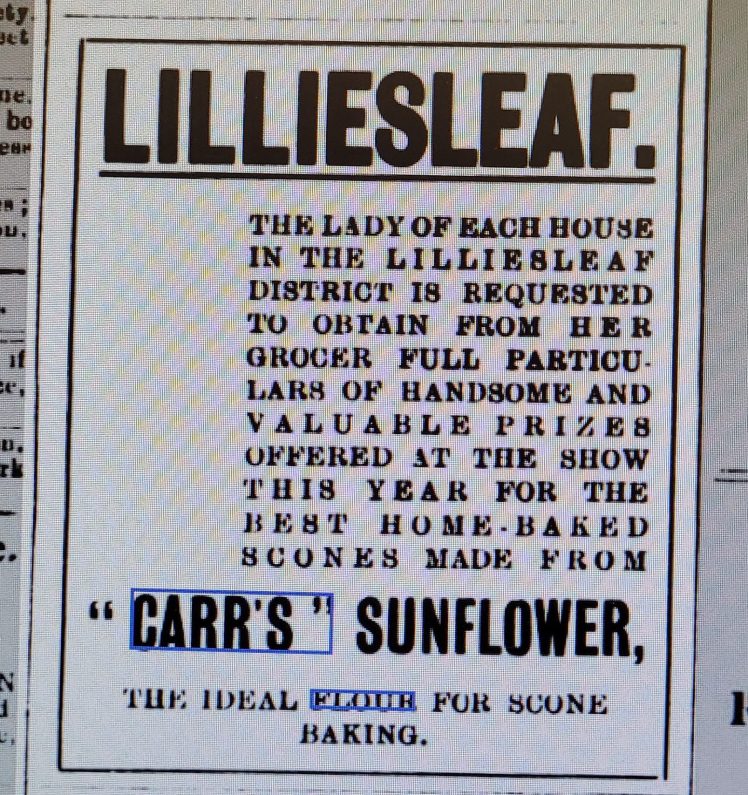
During that same summer, Carr’s are sponsoring prizes for home baking north of the Border in Scotland. But there – for example in Lilliesleaf near Melrose in Roxburghshire – the competition is for the best home-made scones made from Carr’s Sunflower, the ideal flour for scone baking [2]. Interesting to know about this, but not of immediate significance to this blog post, because our concern is with Carr’s CC brand flour for bread and not with Carr’s Sunflower brand flour for scones.
Local flower and agricultural shows continued to be an annual high point in the communal calendar of many towns and villages throughout Britain in subsequent years and decades. But just occasionally the shows were not a high but a low point. Take for example the Keswick show on 8th August:
“The circumstances in which this exhibition were held have been extremely unfortunate – the date being a fortnight earlier than last year, while vegetables and some fruits are fully six weeks behind owing to the very unfavourable season. Competition was very limited … The most noticeable deficiency, all round, was the falling-off in potatoes … Without the particularly good and extensive competition for the prizes given by Mr Adamson, Messrs Carr and Messrs Hindhaugh for bread baking … the Pavilion would have borne but a bare appearance”[3]
Despite which, the Keswick show and many others of the annual shows held in that damp summer of 1907 are still continuing today. If you look at the Keswick Show programme for 2025 here you’ll see that the date has now been moved back to late August (presumably a lesson learned from the falling-off in potatoes in 1907), but that in many other respects time seems to have stood still.
Regretfully I have little to offer the reader by way of personal experience of village shows, other than the Ambridge Flower and Produce Show, which I have attended virtually as a listener for more than seven decades to the BBC Radio 4 show the Archers. Just ask me about Walter Gabriel’s giant leeks. Or Ned Larkin’s, or Bert Fry’s.
And once, just last year, have I attended a real-life show, which led me to observe that the village show phenomenon is perhaps not what it used to be. On a day out with my wife Frances and friends Mary and Ron, we stumbled fortuitously upon a church hall in a Scottish Borders town where the annual show was about to open its doors.
At twelve noon sharp we paid one pound each for entry and spent some minutes (not many) sauntering up and down rows of folding tables upon which were displayed entries (not many) in the various classes of competition: large vegetables, knitting and craft work, flower arrangements, and of course home baking, and others too numerous and banal to mention. The judging had already been completed, and it was soon time for the speeches and presentations, to which a sparse audience (not many) listened with attention (not much) and applied meagre applause at appropriate junctures.
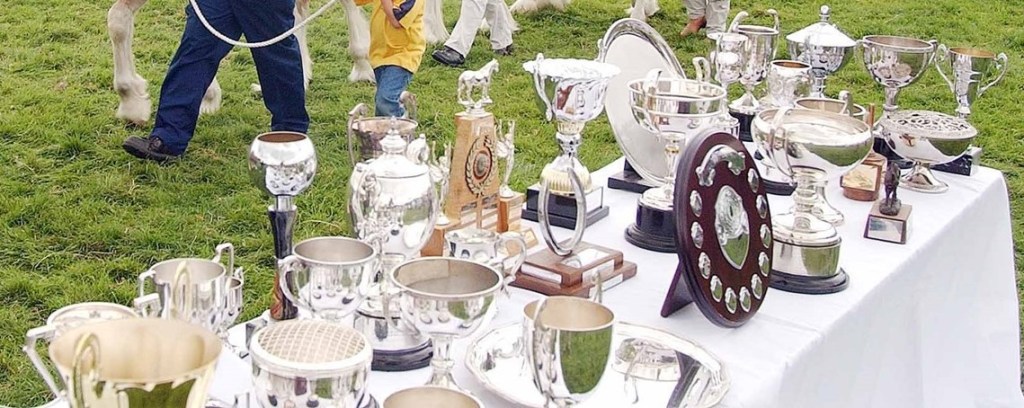
We gained a strong impression that – at least in this particular small Scottish town – we were witnessing the end of an era, the last gasp of a once-vibrant institution, evidenced mainly by the stark contrast between the feeble and amateurish quality of prizewinning competition entries, and the grand and imposing quality of the awards on offer. A long table on the church hall platform sagged under the weight of an array of grandiose silver cups and shields, clearly assembled over many decades of sponsorship from local worthies and tradespeople.
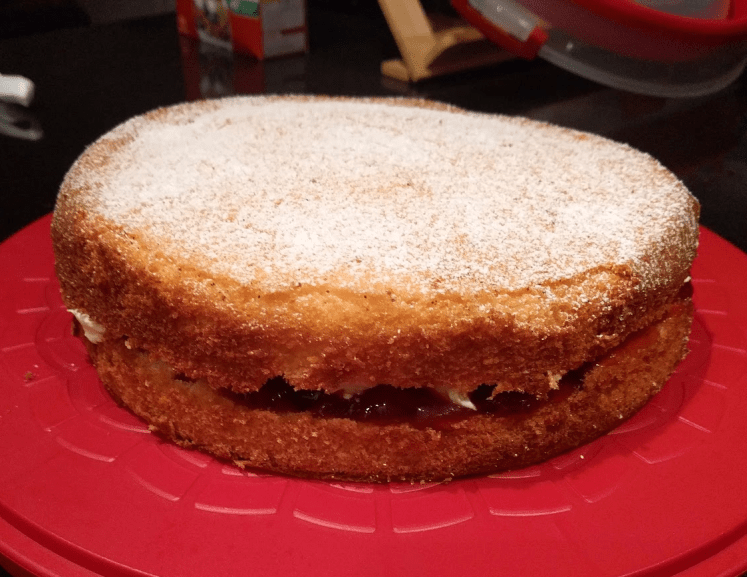
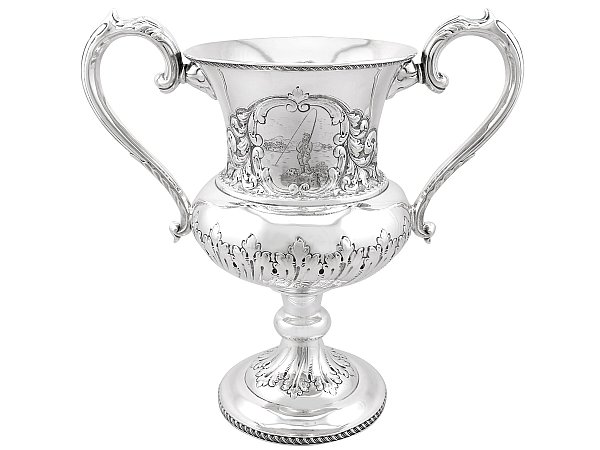
Thus, the winner in the Home Baking category was presented with a large and gleaming silver trophy, entirely over the top as a prize for the offering of a flat, flabby, anaemic Victoria Sponge. An altogether sad, dispiriting experience.
I venture to suggest that back in the 1907 show at St Bees there was no such gross disproportionality between the splendid prize tea service and the magnificent all-conquering loaf exhibited by Mrs Taylor in the Carr’s Home Baking Competition.
Now that you know about the competition, you need to know about the prize, and specifically about the First Prize, a Handsome China Tea Service (40 pieces) awarded at the 1907 St Bees Annual Show to Mrs J J Taylor. That’s what’s in Slice 2 of this five-slice blog post.
Notes
[1] All the material presented about 1907 village shows in this piece has been retrieved from the British Newspaper Archive. Specific information about the St Bees show is from an advertisement in page 2 of The Whitehaven News of Thursday 11 July 1907 and a report on page 5 of The Whitehaven News of Thursday 18 July 1907
[2] Southern Reporter, Thursday 22 August 1907, advertisement on Page 2, retrieved from British Newspaper Archive
[3] English Lakes Visitor & Keswick Guardian, Saturday 10 August 1907, Page 5, retrieved from British Newspaper Archive
 Random Treasure